
what we do
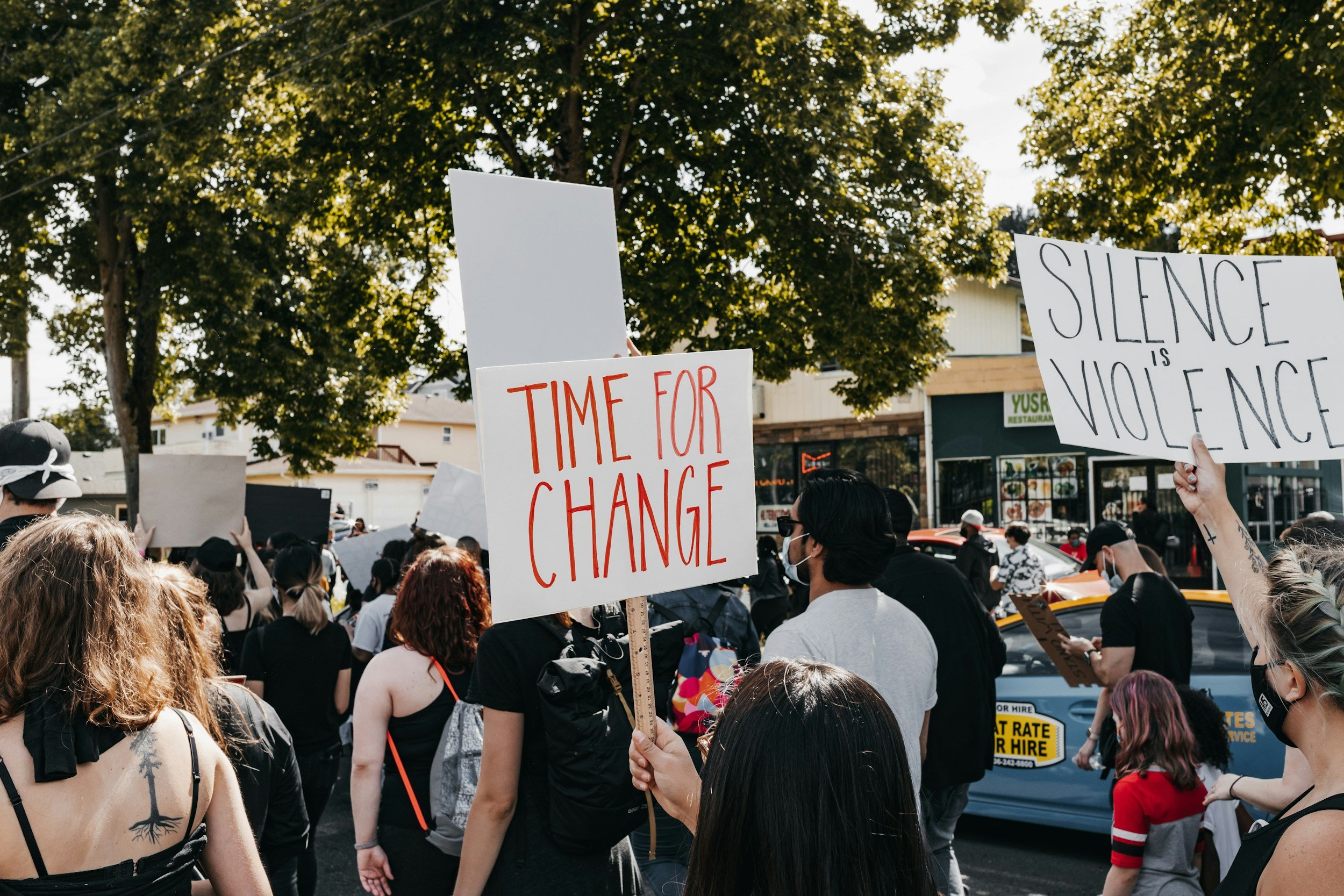
Ceasefire Northwest delivers practical, evidence-informed education to reduce firearm injury—reaching students, educators, and communities across Washington State.
Our work is organized in three core areas:
-
High school firearm injury prevention curriculum
Classroom presentations
Age-appropriate program development (envisioning future work with students in primary and middle school)
Educator support and materials
-
What We’re Studying:
Our research, in collaboration with the University of Washington FIRE (Firearm Injury Reduction Education) program, focuses on two main groups: students and teachers.
For students, we ask:
Do they learn the key lessons about firearm safety and injury prevention?
How do their attitudes toward firearms and safety change after receiving the education?
For teachers, we examine:
How they experience implementing the curriculum in their classrooms
Whether they find the education appropriate, high-quality, and necessary
What challenges or opportunities arise when teaching this material
Groundbreaking Work:
Over the past year and a half, we have collected detailed data in Washington State classrooms. Our study includes 755 students who received the curriculum, compared to 153 students in a control group across five schools. To our knowledge, this is the first study in the United States to systematically measure the effectiveness of high school firearm injury prevention education in this way.
Why This Research Matters:
Understand the true impact of firearm injury prevention education on students
Identify areas where the curriculum can be improved
Provide teachers with evidence-based tools that are practical, safe, and effective
Guide policymakers and educators on best practices for school-based prevention
-
Community talks and workshops
Parent education
Training healthcare professionals
Training of Collaboration with local organizations
Public awareness efforts
impact
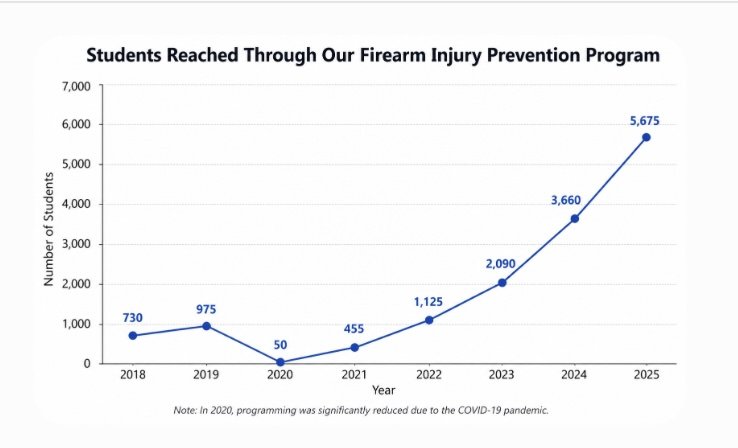
Since 2017 we have reached over 15,000 students in Washington State (over 30 schools and over 10 school districts)! We have yet to receive a complaint from a student, teacher, administrator or parent that our program is biased for or against firearm ownership. We have also launched a new research initiative on parent, teacher and school administrator attitudes toward firearm safety education and are partnering with healthcare and community organizations locally and nationally to expand our impact.
ENDORSEMENTS FOR
FIREARM INJURY PREVENTION EDUCATION
Our approach works because we meet students where they are; we focus on real-life decision-making; we know effective education requires repetition over time; and our work is grounded in public health, not politics.
The following community members, advocacy group individuals and educators support this statement:
I (we) support the inclusion of age appropriate, public health informed firearm injury prevention classroom instruction for high school students in Washington State. I (we) believe that providing students with accurate information and practical tools can help reduce risk and promote safety.
-
Washington Youth Alliance
Horn of Africa Services
Alliance for a Safe Oregon
The Reverend Steven L. Thomason, Dean and Rector, Saint Mark’s Episcopal Cathedral, Seattle, WA
Evangelist-Activist Sandra Allen
Rabbi Daniel Weiner, Temple De Hirsch Sinai, Seattle, WA
Solace
Gun Owners for Responsible Ownership
Wally Webster, President, The ACCESS Project
Rabbi David Basior, Kadima Reconstructionist Jewish Community, Seattle, WA
-
Association of Washington School Principals
Superintendent Joshua J. Garcia, Tacoma Schools
Superintendent John Belcher, Cle Elum Schools
Mickey Lahmann, Assistant Superintendent Washington OSPI (retired)
Bill Lahmann, Superintendent (retired)
Jeff Snell, Executive Director, Washington Association of School Administrators (WASA)
Greg Schwab, Assistant Superintendent, Edmonds School District
Patrick Murphy, Superintendent, Olympia School District
Ben Shuldiner, Superintendent, Seattle Public Schools
Jack Arend, Deputy Director, Association of Washington School Principals
-
Senator Rebecca Saldana, District 37, Washington State Legislature
Senator Lisa Wellman, District 41, Washington State Legislature
Representative Strom Peterson, District 21, Position 1, Washington State Legislature
Senator Jamie Pedersen, District 43, Washington State Legislature
Senator Claire Wilson, District30, Washington State Legislature
Representative Gerry Pollet, District 46, Position 1, Washington State Legislature
Representative Carolyn Eslick, District 39, Position 2, Washington State Legislature
Senator Javier Valdez, District 46, Washington State Legislature
Representative Sharon Tomiko Santos, District 37, Position 2, Washington State Legislature
Representative Monica Jurado Stonier, District 49, Position 2, Washington State Legislature
Representative My-Linh Thai, District 41, Position 2, Washington State Legislature
Senator T’wina Nobles, District 28, Washington State Legislature
Representative Steve Bergquist, District 11, Position 2, Washington State Legislature
Representative Jamila Taylor, District 30, Position 1, Washington State Legislature
Representative Liz Berry, District 36, Position 2, Washington State Legislature
Representative Adison Richards, District 26, Position 1, Washington State Legislature
Senator Tina Orwall, District 33, Washington State Legislature
Senator Adrian Cortes, District 18, Washington State Legislature
Representative Clyde Shavers, District 10, Position 1, Washington State Legislature
Representative Lisa Callan, District 5, Position 2, Washington State Legislature
Representative Alicia Rule, District 42, Position 1, Washington State Legislature
Representative April Berg, District 44, Position 2, Washington State Legislature
Representative Greg Nance, District 23, Position 2, Washington State Legislature
Representative Nicole Macri, District 43, Position 1, Washington State Legislature
Representative Lillian Ortiz-Self, District 21, Position 2, Washington State Legislature
Representative Darya Farivar, District 46, Position 2, Washington State Legislature
Representative Beth Doglio, District 22, Position 1, Washington State Legislature
-
Seattle Children's Hospital
Washington Physicians for Social Responsibility
Washington State Chapter of the American College of Surgeons Committee on Trauma
Washington Academy of Family Physicians
Washington Chapter of the American Academy of Pediatrics
Washington State Medical Association
King County Medical Society
Washington Chapter of the American College of Physicians
Washington State Public Health Association